Showing posts with label SBC. Show all posts

18 August, 2006

BRAKING WITH SBC

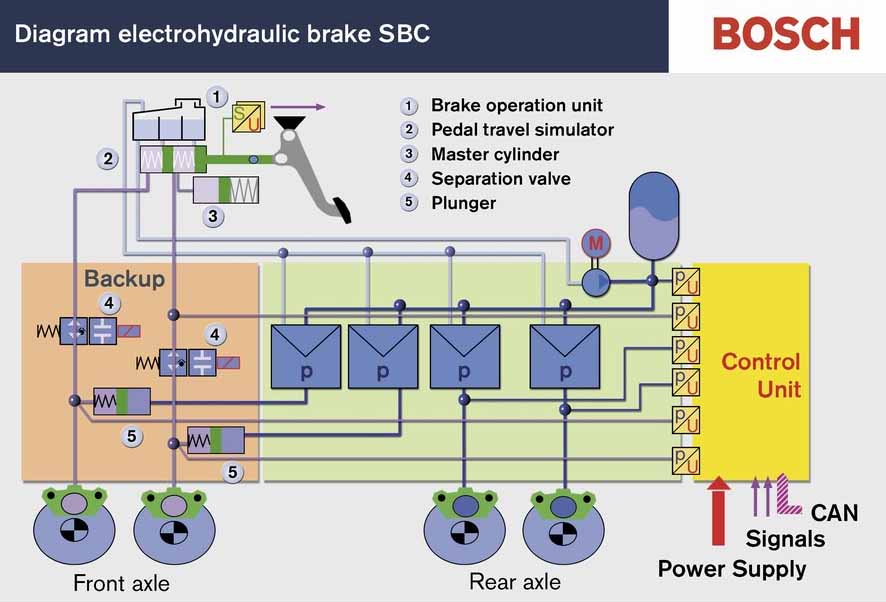
This is the world‘s first brake-by-Wire system in a passenger car, where Mechanical and Hydraulic connections are replaced by electronically controlled functions. A travel sensor and pressure sensor measure speed and power from the driver stepping on the brake pedal. The information received is processed by the control unit (ESP), which sends control signals via CAN to the pressure modulator. The hydraulic unit independently regulates the braking pressure to the individual wheels. This brake pressure is fed into each brake caliper from a high-pressure accumulator via the hydraulic unit. The brake fluid is permanently pressurized in hydraulic unit to approx. 140 bars, so the SBC can implement the brake command instantaneously. The brake pressure for each wheel is calculated using information on the current driving conditions provided by the ESP (Electronic Stability Program). While cornering, higher brake pressure is applied to the outside wheels than the inside, which significantly increases stability while decelerating. If the brake pedal is depressed very quickly, yet not with sufficient force, the system concludes that it‘s an emergency and increases pressure up to the ABS control limit. Most cars with SBC are also fitted with a rain sensor which recognizes the starting of rain. It automatically removes water or salt film on the brake discs by very light regular braking impulses, which means the brake discs will be clean and dry when braking is required. Switching on the windshield wiper activates this function.
The system uses eight separate brake circuits for brake operation.

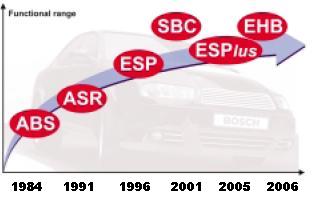
REVOLUTION OF SBC


CARS WITH SBC

1. Mercedes SL roadster (R230)
2. Mercedes E-Class sedan (W211) and Estate (S211) until mid 2006
3. Mercedes E-Class 4matic sedan (W211) and 4matic Estate (S211)
4. Mercedes SLR McLaren (C199)
5. Maybach 57 and 62 (W240)
6. Mercedes CLS coupe (C219)

ADVANTAGES OF SBC


1. SBC STOP: In stop-and-go traffic the vehicle brakes automatically, when the foot is lifted off the accelerator pedal ("Traffic Jam Assist"). It can be engaged under 10 MPH, using the cruise control lever and switches off automatically at higher speeds. It remains active under 40 MPH. When engaged the instrument cluster indicates "SBC S". One can also activate it on downhill slopes via cruise control, so the car won't speed over the set limit.
2. SBC SOFT STOP: In city traffic soft-stop supposedly allows soft, jerk less stopping.
3. SBC HOLD:A "drive-away assistant" prevents the vehicle from rolling backwards or forward when starting on a hill or steep incline.
4. DRY BRAKE:It is always activated when the windshield wipers run. The system then knows, that it rains and, with short brake pulses unnoticed by the driver, keeps the brake discs always dry and fully functional.
5. BRAKING IN A CURVE:Left: conventional. Right: with SBC
6. ELECTRONIC BRAKE PROPORTIONATING:EBP-allows brake proportioning
front to back and side to side.
7.No pedal vibration during ABS operation- eliminates "distraction"
to the driver during critical moments- indicator light in instrument
cluster signals traction loss.
8.Pressure reduction at standstill- reduces stress on components.
9. SHORTER STOPPING DISTANCE 10. BETTER BRAKE RESPONSE 11. EVEN WEAR ON BRAKE PAD LININGS

SENSOTRONIC BRAKE CONTROL (SBC)

Recently automated industry pays more attention on the improvement of the safety and comfort of their vehicle models and provides the latest car by incorporating the new technological innovations like Active body suspension (ABS), Electronic Stability Program (ESP), Sensotronic brake control (SBC) etc.
Sensotronic brake control is an innovative electro hydraulic brake system which gives maximumsafety and comfort on braking. Sensotronic Brake Control (SBC) is the name given to an innovative electronically controlled brake system.
With Sensotronic Brake Control, electric impulses are used to pass the driver's braking commands onto a microcomputer which processes various sensor signals simultaneously and, depending on the particular driving situation, calculates the optimum brake pressure for each wheel. As a result, SBC offers even greater active safety than conventional brake systems when braking in a corner or on a slippery surface. A high-pressure reservoir and electronically controllable valves ensure that maximum brake pressure is available much sooner.
To turn to the technical side: when drivers hit the brake pedal today, their foot moves a piston rod which is linked to the brake booster and the master brake cylinder. Depending on the pedal force, the master brake cylinder builds up the appropriate amount of pressure in the brake
lines which - in a tried and tested interaction of mechanics and hydraulics - then presses the brake pads against the brake discs via the wheel cylinders.